
Metal Building Compliance Checklist: Codes, Inspections & Steps
Following metal building safety requirements keeps structures sound, people safe, and projects within the law. When design, construction, and maintenance meet applicable codes and inspection procedures, owners lower liability, protect insurance, and extend a building’s useful life through proper materials, anchoring, and scheduled checks. This guide gives Northern California property owners a compact, inspection-ready checklist covering codes and permits, structural integrity, operational safety, and the permit-to-final-approval workflow for metal steel buildings. You’ll find which standards typically govern (seismic and wind design, for example), the foundation and anchoring practices inspectors look for, how to maintain electrical and fire systems to meet code, plus step-by-step permit guidance. Practical lists, reference tables, and checklists are included so owners can prepare documents and confirm site readiness for plan check and field inspections. The focus is practical — items you can verify or request from your contractor or engineer to achieve compliance.
Ibarra Construction supports Northern California owners with hands-on compliance help and turn-key services: permit processing, site grading, foundations, and metal building installation. For a local compliance review or a free estimate, contact Ibarra Construction. Ask for owner/operator Diego Ibarra and inquire about warranty options on select metal buildings.
Key Codes & Permit Requirements for Metal Buildings in Northern California
Compliance for metal buildings in Northern California relies on state and national model codes that set rules for structural design, fire safety, and energy performance, while local agencies enforce zoning and permit requirements. The California Building Code (CBC) adopts and amends parts of the International Building Code (IBC) and references ASCE 7 for load criteria; building departments expect engineered plans with stamped calculations showing compliance. Owners should confirm plan sets include structural calculations, manufacturer details for pre-engineered systems, and site-specific reports (soils and grading). The table below summarizes the main code documents and their typical permit roles.
The table below shows which code or standard governs common design and permit items.
| Code / Standard | Primary Focus | Typical Permit Requirement |
|---|---|---|
| California Building Code (CBC) | State adoption, local amendments, and enforcement | Stamped plans, energy compliance forms, code analysis |
| International Building Code (IBC) | Structural and fire provisions referenced by the CBC | Structural design criteria included in plan sets |
| ASCE 7 | Defining loads (wind, seismic, snow) and site coefficients | Engineering calculations for design loads |
Use this summary to check which documents you should request from designers and manufacturers before submitting plans.
How the California Building Code (CBC) Applies to Metal Buildings
The CBC sets mandatory requirements for structural safety, fire protection, egress, and energy performance, and points to the IBC and ASCE 7 for technical design rules. For metal buildings that means the frame, roof, and connections must be engineered to resist assigned wind and seismic forces and documented by a licensed professional. Inspectors commonly verify that stamped plans match installed components, that fire ratings and egress match the occupancy, and that any required energy compliance forms are completed. Make sure your contract documents cite the governing code editions and any local amendments up front.
Which Local Zoning Rules Affect Agricultural and Commercial Metal Buildings?
Local zoning controls permitted uses, setbacks, height limits, and lot coverage. Some Northern California jurisdictions allow agricultural exemptions or conditional use permits that change what’s required. Owners should confirm land-use designation and whether an ag exemption applies, since exemptions can alter required separations, parking, or utility connections. Typical items to check with planning include property lines, floodplain overlays, and special district restrictions that trigger extra review. Verifying zoning early cuts surprises during plan check and keeps your project aligned with local standards.
How to Ensure Structural Integrity and Design Compliance for Metal Buildings
Structural integrity depends on correct load design, material quality, and solid connections. Engineers use ASCE 7 to size members for wind, snow, and seismic forces, then specify frame members, connections, and protective details. Owners should require shop drawings, connection details, and finish/galvanizing specifications in the contract, and ask the manufacturer for material certifications. Regularly review foundation plans and anchor bolt layouts to confirm they match the building’s base plates and load paths. The checklist below covers the primary design items to verify during plan development.
Essential design verifications owners should request:
- Confirm structural calculations use the correct ASCE 7 edition and site-specific coefficients.
- Request mill test reports and material specifications to match the engineer’s design.
- Make sure connection details and anchor-bolt patterns are shown and align with foundation drawings.
- Require a soils report and grading plan to validate foundation bearing capacity and design assumptions.
These checks tie your plans to on-site verification during inspections and reduce the chance of rework.
| Design Element | Attribute Checked | Inspection Evidence |
|---|---|---|
| Wind / Seismic Loads | ASCE 7 references and site coefficients | Stamped calculations, load diagrams |
| Material Quality | Steel grade, coating, and certifications | Manufacturer mill certificates |
| Connections & Anchors | Bolt patterns, weld details, anchor spacing | Shop drawings and as-built verification |
Reviewing this table with your engineer helps avoid common plan-check corrections.
Wind, Snow, and Seismic Load Standards for Steel Structures
ASCE 7 defines load combinations and site-specific coefficients used for wind, snow, and seismic design. In Northern California seismic demands often control member and connection sizing because of elevated ground-motion values. Engineers convert ASCE 7 outputs into member sizes, bracing layouts, and foundation embedment depths; inspectors check that calculations reflect the as-built conditions and anchorage. Always ask which ASCE 7 edition and site parameters were used so plan-check reviewers can confirm compliance.
Which Foundation and Anchoring Practices Meet Safety Standards?
Common foundations for metal buildings include slab-on-grade with edge beams, isolated column footings, or continuous shallow footings sized to the loads and soil bearing capacity in a soils report. Anchor bolt spacing, embedment, and base-plate designs should match the manufacturer’s details and the engineer’s pull-out checks to resist uplift and lateral forces. At inspection, confirm anchor bolts are set within tolerance and that grout and plate leveling meet specifications. Proper grading, compaction, and verified soil assumptions significantly affect foundation performance and long-term stability.
Operational Safety Measures and Maintenance for Metal Buildings
Operational safety blends fire protection, electrical code compliance, and a routine maintenance program to preserve structural systems over time. Fire code covers occupancy classification, egress, fire-rated assemblies, and suppression where required. Electrical code governs wiring methods, panel access, grounding, and bonding in metal buildings. A scheduled maintenance program helps owners catch corrosion, loose fasteners, or grounding issues before they become hazards. The table below gives a concise maintenance checklist owners can use to set inspection frequency and actions.
The maintenance table lists components, suggested inspection frequency, and primary actions to keep systems compliant and safe.
| Component | Inspection Frequency | Key Actions |
|---|---|---|
| Roof seams & fasteners | Semi‑annual | Check for leaks, tighten fasteners, reseal roof penetrations |
| Anchor bolts & base plates | Annual | Verify torque, inspect for corrosion, confirm grout integrity |
| Electrical systems | Annual | Confirm panel access, grounding continuity, and circuit labeling |
Use this table to set a predictable maintenance rhythm that preserves structural integrity and eases inspector review.
This short maintenance checklist helps owners prioritize routine tasks.
- Roof and cladding inspection: Inspect fasteners, sealants, gutters, and flashings for leaks or corrosion.
- Foundation and anchors: Check anchor-bolt torque, grout condition, and monitor for settlement at column bases.
- Electrical and fire systems: Ensure panels are labeled, grounding/bonding is intact, and egress lighting works.
Doing these checks on schedule reduces risk and simplifies final inspections.
How Fire Safety Codes and Electrical Rules Apply
Fire safety is based on occupancy classification and demands proper egress, fire-rated assemblies where required, and suppression systems for certain uses. Metal buildings must meet the same life-safety standards as other construction types. Electrical compliance requires correct grounding and bonding of metal systems, appropriately rated panels, and code-compliant conduit and wiring methods in exposed conditions. Inspectors typically verify egress routes, emergency lighting, panel labeling, and bonding/grounding continuity during final approval. Keep certificates for suppression systems and electrical permits available for inspections.
Which OSHA Guidelines Apply During Construction and Maintenance?
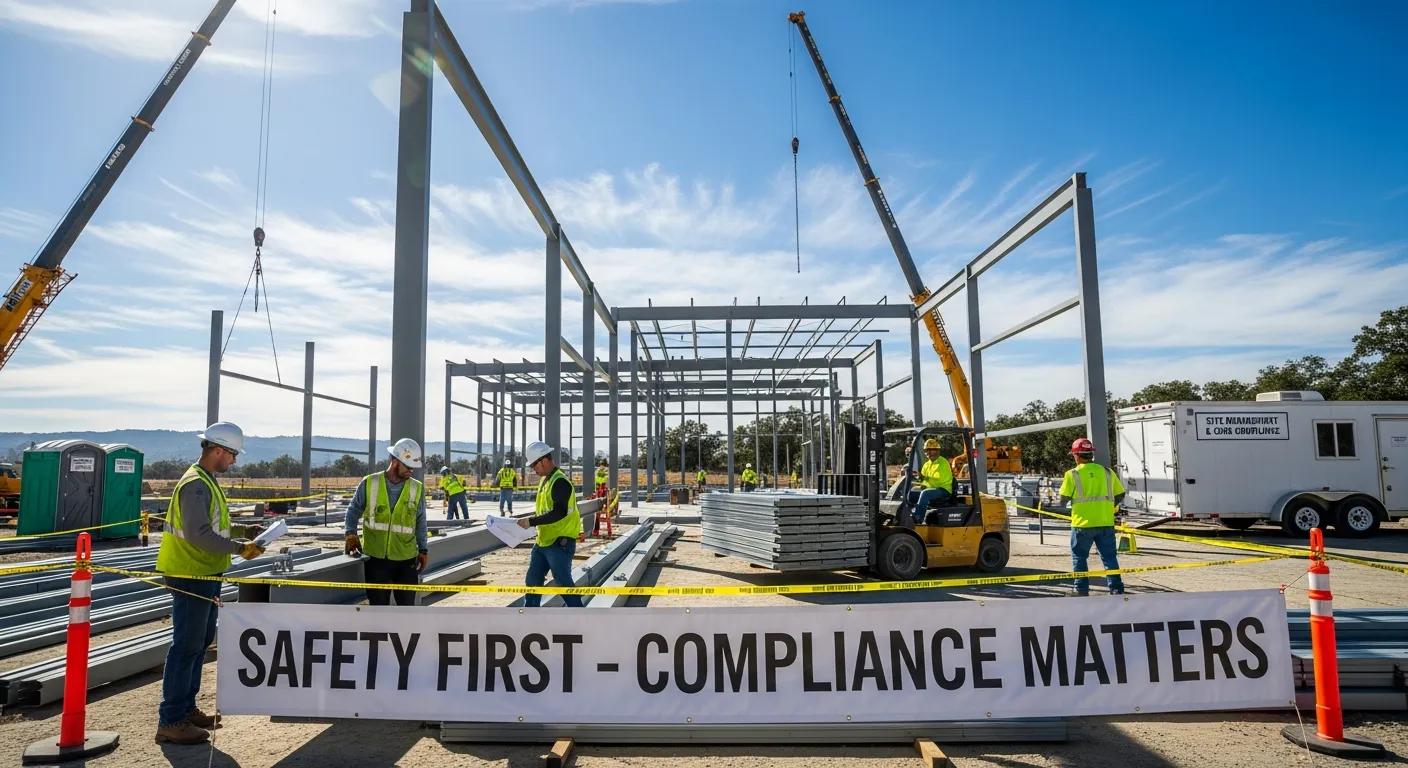
OSHA standards for steel erection, fall protection, rigging, and cranes apply during construction and major maintenance. Owners should require contractors to follow OSHA Subpart R for steel erection, maintain fall-protection systems, and document safety meetings and equipment inspections. Keeping inspection logs, signed safety plans, and daily site records supports compliance and provides evidence if questions arise. Specifying these safety practices in contracts promotes a culture of compliance that protects workers and projects.
Navigating Permit Processing and Inspections for Agricultural and Commercial Metal Buildings
Permit processing follows a predictable path: site evaluation and reports, submittal of engineered plans and calculations, plan-check revisions and permit issuance, and staged inspections through final approval. Typical inspection milestones include footing/foundation, framing/erection, and final occupancy or completion checks; inspectors compare field conditions to stamped plans at each stage. Contractors like Ibarra Construction offer turn-key permit processing, site grading, foundations, and inspection coordination to streamline submissions and reduce back-and-forth. The steps below outline a usual permit workflow for owners.
- Pre-application: Assemble a soils report, site plan, and manufacturer specs for pre-submittal review.
- Plan submittal: Submit engineered drawings, ASCE 7 calculations, and structural/shop drawings to the building department.
- Plan check and corrections: Address reviewer comments, revise plans, and resubmit until approval is issued.
- Inspections: Schedule footing, framing/erection, and final inspections; have approved plans available on site.
Following these steps keeps the project on schedule and prepared for each inspection milestone.
Steps for Obtaining Building Permits for Metal Structures
A clear submission path reduces delays: confirm zoning and required reports, compile engineer-stamped plans and manufacturer data, submit to your local building department, and track plan-check comments through permit issuance. Common pitfalls include missing soils reports, incomplete energy forms, or mismatched anchor bolt layouts between plans and shop drawings. Coordinating pre-submittal with the manufacturer and engineer minimizes corrections and sets accurate inspection expectations. Keep a record of each submittal and response to speed communication with plan checkers and inspectors.
How Safety Inspections Are Conducted and What Owners Should Bring
Inspectors follow a sequence focused on load transfer and code compliance: footing/foundation checks confirm correct anchor placement and embedment; framing/erection inspections verify member sizes and connections; final inspections confirm egress, fire protection, and electrical installations. Owners should keep approved plans, calculations, and manufacturer installation instructions on-site, provide clear site access, mark anchor locations, and ensure trenches are safe for inspection. A simple owner checklist includes site access, the approved plan set, anchor-bolt layout verification, and required material certifications.
Ibarra Construction provides permit processing and inspection coordination as part of its turn-key services — from plan submission and site grading to foundations and on-site inspection support — to help owners navigate Northern California jurisdictions successfully.
For a free estimate or a compliance assessment tailored to Northern California properties, request a consultation with Ibarra Construction and ask for owner/operator Diego Ibarra to review your metal building plan set.
Frequently Asked Questions
What common challenges do property owners face during the permit process for metal buildings?
Owners commonly run into local zoning complexity, incomplete documentation, and plan-check comments that require revisions. Missing soils reports, unfinished energy compliance forms, or mismatches between plans and shop drawings are frequent causes of delays. Local jurisdiction requirements also vary, so working with experienced contractors or consultants who know the local process can prevent surprises and speed approval.
How can property owners best prepare for inspections of their metal buildings?
Prepare by keeping approved plans, calculations, and manufacturer installation instructions on site. Mark anchor-bolt layouts, keep the site safe and accessible for inspectors, and use a simple checklist that covers site access, structural verification, and required material certifications. Engaging contractors familiar with inspection protocols helps ensure readiness and reduces re-inspection time.
What role do engineers play in ensuring compliance for metal buildings?
Engineers provide structural calculations, design details, and stamped plans that meet state and local codes. They size members for wind, snow, and seismic loads, specify materials and connections, and support permit submissions and inspections. Their input is critical for technical questions during plan check and for confirming construction matches approved designs.
What maintenance practices are essential for the longevity of metal buildings?
Key practices include regular inspections of roof seams, fasteners, and electrical systems to catch issues early. Schedule semi‑annual checks for roof leaks and corrosion, annual checks for anchor bolts and base plates, and regular verification that electrical panels are labeled and grounded. A structured maintenance program preserves structural integrity, supports code compliance, and avoids costly repairs.
How do fire safety regulations affect the design of metal buildings?
Fire safety requirements influence egress paths, fire-rated assemblies, and the need for suppression systems depending on occupancy. Designers must consider occupancy classification and include the necessary fire protection features and exit routes. Meeting these regulations is essential for permitting and for protecting building occupants.
What are the benefits of hiring a contractor for compliance support in metal building projects?
Hiring a contractor with compliance experience saves time and reduces risk. Contractors can navigate codes and local rules, prepare and submit complete documentation, coordinate with plan checkers, and manage inspections. They also provide field expertise during construction to help ensure work meets approved plans and applicable safety standards.
Conclusion
Meeting metal building safety requirements protects owners, occupants, and the investment in the property. Follow the codes, checklists, and permit steps in this guide to reduce delays and keep your project on track. For local help, Ibarra Construction offers practical, hands-on support — from permitting to installation — so you can move forward with confidence. Contact us to get started on a compliant, durable metal building solution.